

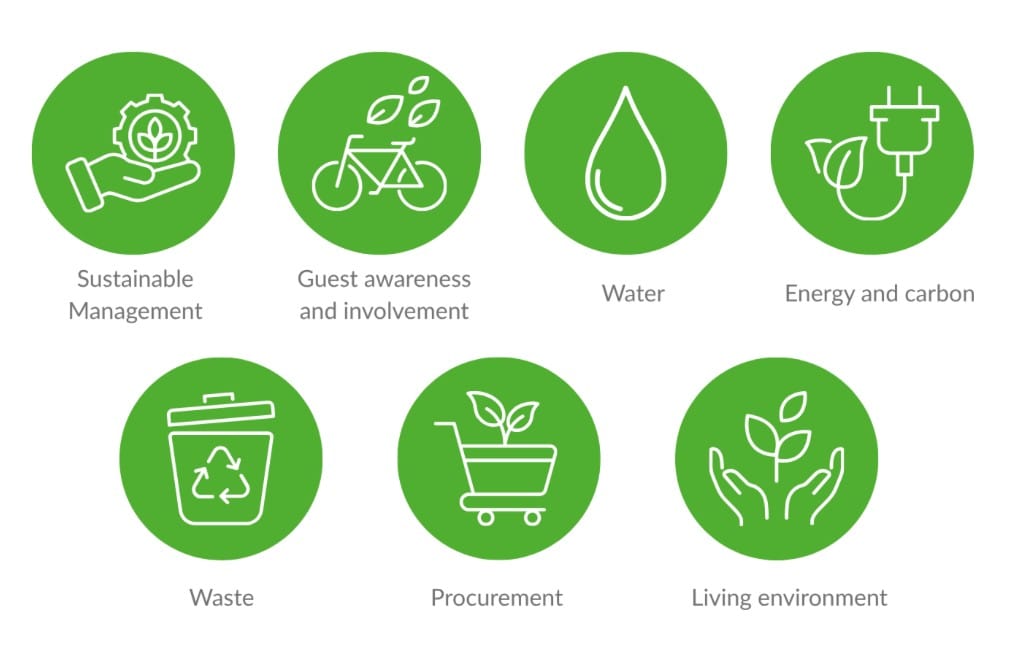
Green Key certified establishments meet a set of high standard environmental requirements. The Green Key criteria and their explanatory notes for the period 01 October 2026 – 31 December 2031 are available to all interested parties and can be downloaded below. We have developed criteria and explanatory notes for the six Green Key categories (hotels and hostels, campsites and holiday parks, small accommodations, conference centres, restaurants, and attractions) covering the following 7 criteria areas.
Green Key categories
A new Green Key criteria have been developed for the below 6 categories effective 01 October 2026 - 31 December 2031.
To familiarize yourself with the new criteria effective 01 October 2026, please check the below files:
- Green Key Criteria & Explanatory Notes 2026-2031_English Version
- Green Key Criteria & Explanatory Notes 2026-2031_Arabic Version
- Category Definitions 2026-2031
- Scope Clarification 2026-2031
- Glossary 2026-2031
To confirm elibility,Tadweera in its capacity as the Green Key National Operator will send the establishment a template to fill in to make sure the establishment is eligible to the Green Key Certificate. Then, Tadweera will complete a Pre-Screening Assessment Form and forward it to the Certification Body.
Certification Process from October 2026
This page will guide you through the certification process, which consists of five steps:
- Submit the application documents
- On-site certification audit
- Certification decision
- Ongoing conformity during the certification period
- Renewal of certification
STEP 1: Submit the application documents
Before the official certification process starts, an establishment expresses interest in Green Key certification.
Application process:
- The establishment contacts Tadweera to express their interest given it is the Green Key National Operator in Egypt.
- Green Key Management reviews the eligibility of the establishment.
- Eligible establishments receive:
- information about the criteria and certification process
- details about the required documentation
- access to the online application form
Application requirements:
The establishment must:
- Complete the online application form
- Submit the required supporting documents
- Sign and return the certification agreement
- Pay the Green Key levy (participation fee)
Green Key Management reviews the submitted materials to ensure that all required information has been provided and to confirm the scope of certification.
Note: Some countries have fixed application deadlines, while others accept applications throughout the year. Please contact your Green Key Management for more information.
STEP 2: On-site certification audit
Once the application has been reviewed, a third-party auditor is assigned to conduct an on-site certification audit.
Scheduling the audit
The auditor contacts the establishment to schedule the audit date.
The applicant establishment pays the annual Certification Body fee and the auditor costs.
Before the on-site audit, the auditor receives all application documents from Green Key Management.
Audit process
The on-site certification audit typically includes:
- Opening meeting
- Document verification (may also be conducted in advance)
- Visual inspection of the establishment
- Audit summary and closing discussion
The audit usually takes 2–6 hours, depending on the size and number of employees of the establishment.
After the audit, the auditor prepares an audit report describing the findings.
Possible outcomes:
A - Full conformity
- The audit report is sent to the Certification Body for final review and decision.
B - 1–5 non-conformities
- The establishment must submit additional evidence addressing the non-conformities.
- Documentation must be submitted within two months.
- The auditor reviews the additional evidence and sends the audit report to the Certification Body for final review and decision.
C - More than 5 non-conformities
- The establishment must submit additional evidence and undergo a follow-up on-site audit.
- Documentation must be submitted within two months.
- The auditor reviews the additional evidence, conducts the follow-up audit and sends the audit report to the Certification Body for final review and decision.
- Please note that the establishment must cover additional audit and travel costs.
STEP 3: Certification decision
An independent entity (Certification Body) reviews the final audit report and takes a decision as to whether the establishment fully conforms with the required Green Key criteria.
The Green Key Management informs the establishment.
If certification is granted, Green Key Management sends the certificate valid for two years.
STEP 4: Ongoing conformity during the certification period
During the certification period, the establishment must continuously conform with Green Key requirements.
If the establishment cannot maintain conformity, it must inform Green Key immediately so the certification can be temporarily suspended.
Handling complaints
If complaints are received during the certification period:
- The establishment must respond to enquiries from the Certification Body.
- If the complaint is confirmed, the establishment must correct the non-conformities.
- Certification may remain suspended until conformity is restored.
Surveillance activities
Between 8–14 months after certification, the establishment must undergo surveillance activities.
This includes providing updated documentation demonstrating ongoing compliance with selected Green Key criteria identified by Green Key.
If surveillance activities reveal non-conformities:
- The establishment must correct the issues.
- Certification may remain suspended until compliance is restored.
Certified establishments must also pay the annual Green Key levy (participation fee) and annual Certification Body fee to maintain certification.
STEP 5: Renewal of the certification
Approximately 6–8 months before the certificate expires, the Green Key management contacts the establishment to encourage renewal.
To renew certification, establishments must again complete:
- Step 1: Application
- Step 2: Audit
- Step 3: Certification decision
For renewal, establishments must demonstrate increased conformity with Green Key criteria, as outlined on the criteria page.
You can also see the Green Key certification timeline document for an overview of the process.
Duration of the certification process
The Green Key certification process typically takes 4–6 months.
The exact timeline depends on factors such as:
- The establishment’s readiness to meet the criteria
- Timely submission of complete documentation
- Payment of participation fees
- Processing time by Green Key Management
- Auditor availability for on-site audits
- Follow-up after the on-site audits in case of non-conformities
- Time required for the Certification Body’s decision
Transition period 2026-2028
With the introduction of the new manual, Green Key is changing the certificate validity period from 12 months to 24 months and adjusting the audit frequency.
During the transition period (1 October 2026 – 31 December 2027), the following cases apply:
Case 1: New applicants
- Establishments must conform with the new criteria.
- An on-site audit is conducted by a third-party auditor.
- Certification is granted by the Certification Body.
- The certificate is valid for two years.
Case 2: Re-certification with on-site audit required
- Establishments must conform with new criteria and transition requirements related to guideline criteria.
- An on-site audit is conducted by a third-party auditor.
- Certification is granted by the Certification Body.
- The certificate is valid for two years.
Case 3: Re-certification with off-site audit required
- Establishments must demonstrate conformity with selected criteria through surveillance activities under the new system.
- A desktop review of compliance is conducted by the Certification Body.
- The Certification Body confirms the continued certification.
- The certificate is extended for one year.
NOTE
Please note that the Green Key application and certification process in general takes three to six months. The exact time depends on the readiness of the applicant establishment in relation to the compliance with Green Key criteria, the delivery of correct material and payment of participation fees by the applicant establishment, Green Key’s management, and the availability of the auditor in relation to audits.
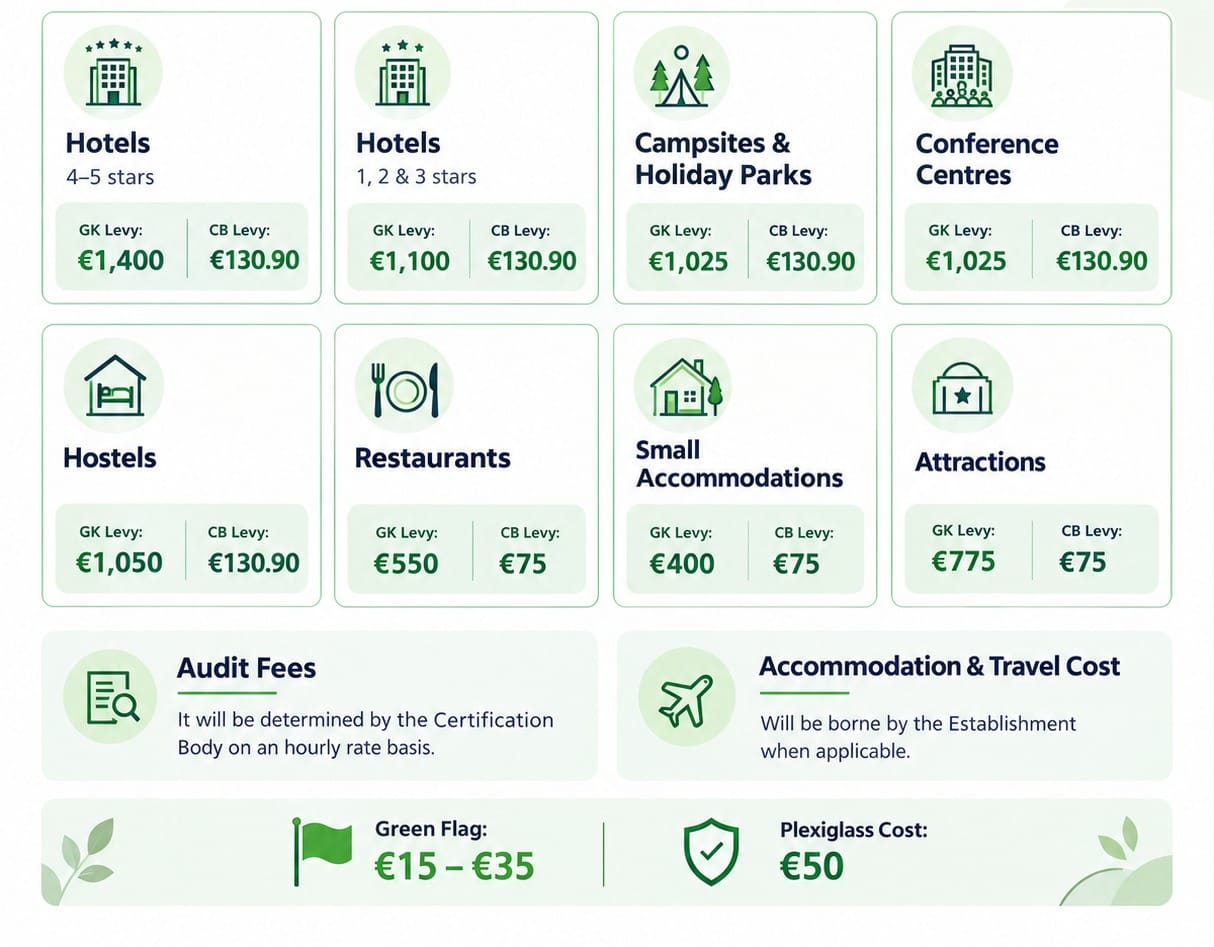
Green Key Programme Participation costs 1 October 2026 - 31 December 2027
With the changes in Green Key’s criteria and certification processes taking effect 1 October 2026, the participation costs are changing accordingly.